
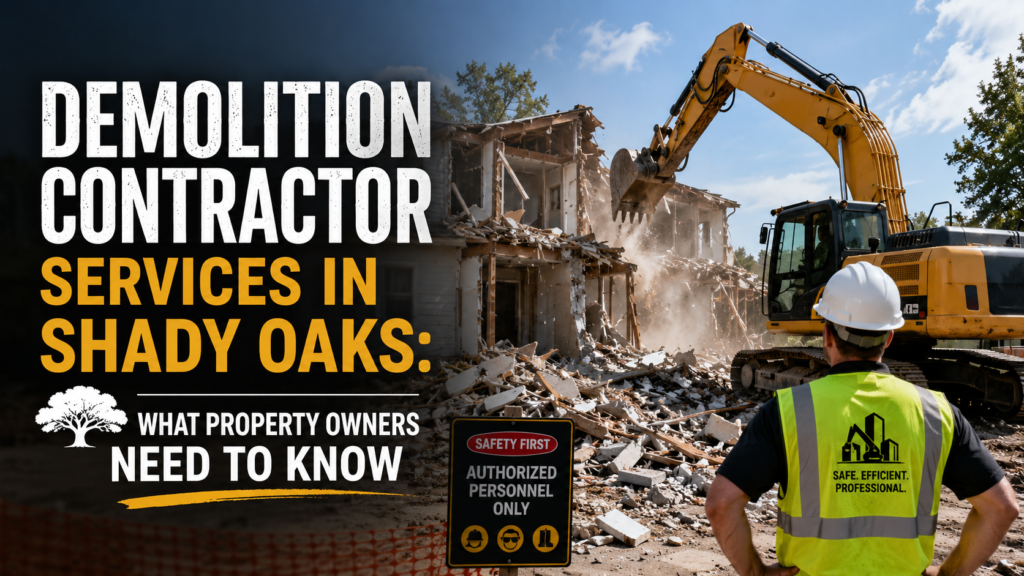
Shady Oaks is a community in the Montgomery County area of North Texas, in the greater Lake Conroe and Conroe metropolitan region. The name reflects a characteristic of many of the residential communities in this part of Montgomery County a landscape of mature hardwood and pine trees that provides natural shade, a sense of privacy, and the peaceful quality that draws residents away from Houston’s urban core. Demolition Contractor Shady Oaks and similar wooded residential communities in Montgomery County address the needs of property owners engaged in improvement, replacement, and redevelopment of properties within this natural setting.
What Demolition Contractors Do
Understanding what a demolition contractor actually provides helps property owners in Shady Oaks scope their projects accurately and identify the right professional for their needs. A full-service demolition contractor in the Montgomery County area provides:
- Pre-demolition assessment and planning: Site visit, structure evaluation, identification of any hazardous materials requiring survey or abatement, utility disconnection coordination, and project sequencing planning.
- Hazardous material abatement coordination: For structures containing or suspected of containing asbestos or lead paint, coordination with licensed survey firms and abatement contractors to fulfill Texas TCEQ requirements.
- Structural demolition: The physical removal of structures using appropriate equipment excavators, skid steers, and associated attachments in a controlled, safe sequence.
- Debris removal and disposal: Loading demolished materials onto haul trucks and transporting them to licensed facilities recycling facilities for metals, concrete, and clean wood; Type IV solid waste landfills for mixed demolition debris.
- Site cleanup and grading: Leveling and stabilizing the cleared site in preparation for its next use, including topsoil grading, erosion control seeding, and any needed backfilling.
The Importance of Asbestos Awareness in Shady Oaks
Many residential structures in the Shady Oaks area were built during periods when asbestos-containing materials were standard in construction. The 1950s through early 1980s saw extensive use of asbestos in floor tiles, ceiling tiles, pipe insulation, duct insulation, roofing felt, textured coatings (acoustic and popcorn ceilings), siding, and miscellaneous products. Texas follows federal NESHAP regulations for commercial and large residential demolition and has additional TCEQ requirements that apply to certain project types.
The practical implication for Shady Oaks property owners is straightforward: before any demolition of a structure built before 1981, a licensed asbestos inspector should survey the structure. If regulated ACM (asbestos-containing material) is identified, licensed abatement contractors must remove and properly dispose of it before demolition proceeds. Skipping this step creates health risks for workers and neighbors, potential regulatory liability for the property owner, and in some cases criminal exposure.
Protecting Trees During Demolition in Shady Oaks
The wooded character of communities like Shady Oaks means that demolition work frequently occurs in close proximity to mature trees whose roots extend well beyond their visible trunk diameter. Root zone damage caused by equipment compaction, excavation within the root zone, or changes in soil grade that alter drainage around the root system can stress or kill mature trees even when the above-ground portions appear undamaged immediately after the work.
Protecting trees during demolition requires planning: establishing temporary protection barriers at the drip line of significant trees before any equipment enters the site, selecting equipment appropriately sized for the space constraints, and hand-demolishing areas immediately adjacent to protected trees. Property owners in Shady Oaks who place high value on the mature trees that give the community its name should discuss tree protection specifically with any demolition contractor they engage, obtaining specific commitments about the protection measures that will be implemented.
Post-Demolition Site Restoration in Montgomery County
After demolition in Shady Oaks, the cleared site requires appropriate restoration. In Montgomery County’s climate hot, humid summers with significant rainfall and hurricane season weather events exposed, bare soil on a cleared lot is vulnerable to erosion. Prompt grading and seeding or sodding of the cleared area, combined with appropriate silt fencing at site boundaries, prevents soil loss and protects neighboring properties from sediment-laden runoff.
For lots being cleared for new construction, soil testing prior to construction helps identify any subgrade conditions soft spots, expansive clay areas, high water table zones that affect foundation design. Demolition contractors who provide comprehensive site preparation services following clearance offer the efficiency of a single coordinated engagement rather than multiple separately managed phases.
Conclusion
Demolition contractor services in Shady Oaks combine the technical competency of professional structural demolition with the environmental sensitivity appropriate to a wooded residential community in Montgomery County. Property owners who approach their demolition projects with awareness of the hazardous materials requirements applicable to their structure’s construction era, the tree protection considerations specific to their wooded setting, and the importance of proper post-demolition site restoration are positioned to execute projects that clear the way for improvements while respecting the natural character that makes their community worth investing in.